

Enter your cycle details to calculate your fertile window
Last Menstrual Period
Cycle Length (days)
Period Length (days)
Menstruation
Fertile Window
Ovulation Day
Predicted Period
Ovulation Date
Fertile Window
Next Period
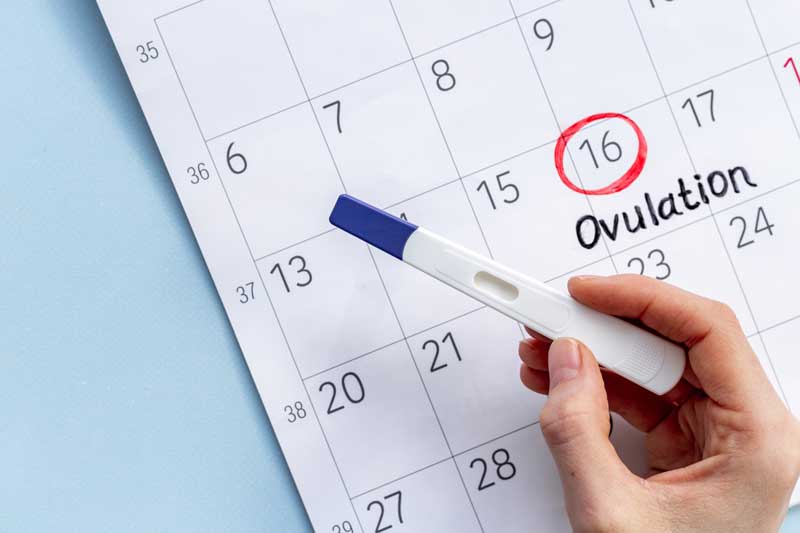
Using an ovulation calculator is simple and requires just a few key details about your menstrual cycle:
Enter the first day of your last menstrual period.
Input your average cycle length (typically between 21–35 days).
Submit the details to generate your ovulation date and fertile window.
The calculator estimates your ovulation day and highlights the days when you are most likely to conceive. For best results, ensure your cycle data is accurate and consistent.

An ovulation calculator pinpoints the days when you are most fertile. This helps you plan intercourse during the optimal time for conception rather than relying on guesswork.

By focusing on your most fertile days, the calculator improves the likelihood of successful conception. It provides a targeted approach instead of random timing.

Regular use helps you track patterns in your cycle, giving better insight into ovulation timing and hormonal changes throughout the month.

If your predicted ovulation dates vary widely each month, it may indicate irregular cycles. This can prompt a timely medical consultation.

Instead of estimating based solely on calendar dates, the calculator offers a more structured, data-driven prediction.

Manual tracking requires daily monitoring and calculations, while the calculator provides instant results with minimal effort.

Over time, consistent tracking helps build a clearer fertility profile, which can be useful for both natural conception planning and clinical consultations.
You may notice several physical and hormonal changes around ovulation. Common signs include:

These signs, when observed alongside a calculator, can improve ovulation prediction accuracy.
Your menstrual cycle is more than just your period; it’s a dynamic process driven by hormonal shifts, typically lasting between 21 to 35 days. It affects your mood, energy levels, skin and even your sleep. By learning how each phase of the cycle works, you can make informed choices for your health and confidently rely on tools like a period tracker, ovulation calculator, or a menstrual calculator.

This is the first phase and starts on Day 1 of your cycle, the day bleeding begins. This is when your body releases the built-up lining of the uterus as menstrual bleeding, which can last between 3 to 7 days, and the flow varies for everyone.
Hormones like estrogen and progesterone are at their lowest, which can cause lower energy levels. Follicle-stimulating hormone (FSH) begins a gentle rise to recruit follicles for the next cycle.

This phase begins on the first day of your period and continues until ovulation. As estrogen levels rise, your ovaries start developing follicles, and usually one grows into a mature egg. You might feel more energetic, clear-headed and motivated during this time.
Gradual estrogen increase boosts mood, mental clarity and skin health. FSH stimulates early follicle growth, while rising estradiol and inhibin from the dominant follicle temper FSH as ovulation nears.

Ovulation usually occurs mid-cycle, but it varies depending on the total length of your cycle. A spike in luteinising hormone (LH) causes your ovary to release a mature egg, and this is accompanied by a brief mid-cycle rise in FSH.
Ovulation symptoms may include:
Yoga & Relaxation
Strength Training
Pregnancy-safe Exercises
Pelvic Floor & Core Workouts

This phase starts after ovulation and continues until your next period, usually lasting 12 to 16 days. During this time, your body makes more progesterone to prepare for a possible pregnancy.
If the egg isn’t fertilised, hormone levels drop, and PMS symptoms may appear, such as:
Mood swings
Breast tenderness
Bloating
Food cravings
In this phase, the progesterone hormone dominates; FSH remains relatively low, and estrogen falls before your next period, leading to possible mood changes.
If pregnancy doesn’t happen, your period starts, and the cycle begins again.
If your period tracker or menstrual cycle calculator shows irregular patterns or missed cycles, underlying medical conditions could be the reason. Understanding these can help you take control of your reproductive health.

Polycystic Ovary Syndrome causes hormonal imbalances that often lead to missed or irregular periods.

An underactive or overactive thyroid can interfere with hormone regulation and lead to irregular menstrual cycles.

Tissue similar to the uterine lining grows outside the uterus, often leading to painful periods and irregular bleeding.
If your period tracker or menstrual cycle calculator shows irregular patterns or missed cycles, underlying medical conditions could be the reason. Understanding these can help you take control of your reproductive health.
By entering just a few cycle details, the app uses smart algorithms to calculate ovulation dates, fertile windows, and period predictions. It doubles as an ovulation calculator, fertility calculator, safe period calculator, and even a menstrual cycle calculator, helping users track more than just dates. It also provides daily wellness tips, blog suggestions, and alerts based on your mood, symptoms and goals.
Whether you're tracking PMS or trying to conceive, the period tracker becomes more accurate the more you use it, adapting to lifestyle changes, stress levels, and other factors. It's also one of the best tools when you're looking for the best time to get pregnant after period calculator recommendations.
Your period can tell you a lot about your overall health. While it’s different for every person, common symptoms may offer clues about your cycle and what your body needs.
Emotions: Mood swings are common due to hormonal shifts.
Bleeding: Duration and flow may differ from cycle to cycle.
Skin Changes: Hormonal changes can cause acne or dryness.
Pain: Many experience cramps, headaches, or lower back pain.
Sex & Libido: Desire may decrease or increase around your period or ovulation.
Vaginal Discharge: Discharge may change in consistency and colour throughout your cycle.
Using tools like an ovulation period calculator or a fertile days calculator can help correlate these changes to your ovulation schedule and predict patterns better.
Missed periods can be caused by several factors. If your period calculator or period tracker shows irregular patterns, here are some possible reasons to consider:

Stress: High stress can impact hormone levels and disrupt the fertility calculator.
Medical Conditions: PCOS, diabetes, orthyroid disorders may disrupt your cycle.
Sudden Weight Fluctuations: Rapid gain or loss can affect menstruation.al changes can cause acne or dryness.
Menopause/Pre-Menopause: Hormonal shifts during this transition can cause irregular or missed periods.
Pregnancy: A common cause of missed periods—use a pregnancy ovulation calculator to understand your fertility window.

Track signs of ovulation or ovulation symptoms, use an ovulation calculator, and maintain a healthy lifestyle. Intercourse during the fertile window increases chances.
Yes, both physical and emotional stress can delay ovulation by affecting hormone production.
Ovulation calculators provide estimates based on cycle data. They are fairly accurate for regular cycles but may be less reliable for irregular periods.
Common signs include changes in cervical mucus, a slight rise in body temperature, mild abdominal pain, and increased libido.
Not always. While many women have regular cycles, ovulation timing can vary due to stress, health conditions, or lifestyle changes.
Ovulation day is when the ovary releases an egg, while the fertile window includes the 4–5 days leading up to ovulation and the ovulation day itself.
On ovulation day, a mature egg is released from the ovary and travels down the fallopian tube, where it can be fertilised by sperm.
Yes, ovulation day is one of the most fertile days. However, pregnancy is also possible in the days leading up to ovulation since sperm can survive for several days inside the body.

 Best Gynecologists in Bellandur Best Gynecologists in Electronic City Best Gynecologists in HRBR LayoutBest Gynecologists in Jayanagar Best Gynecologists in Kanakapura RoadBest Gynecologists in Malleswaram Best Gynecologists in Nagarbhavi Best Gynecologists in Old Airport RoadBest Gynecologists in Sahakarnagar Best Gynecologists in Sarjapur RoadBest Gynecologists in ThanisandraBest Gynecologists in Varthur RoadBest Gynecologists in Whitefield Best Gynecologists in Industrial Area Phase IIBest Gynecologists in OMRBest Gynecologists in T NagarBest Gynecologists in New Industrial TownBest Gynecologists in IndirapuramBest Gynecologists in Golf Course RoadBest Gynecologists in Sector 14Best Gynecologists in Sector 47Best Gynecologists in Banjara HillsBest Gynecologists in GachibowliBest Gynecologists in Hitech CityBest Gynecologists in KompallyBest Gynecologists in Gomti NagarBest Gynecologists in MaladBest Gynecologists in NerulBest Gynecologists in VashiBest Gynecologists in Kailash ColonyBest Gynecologists in PatparganjBest Gynecologists in Punjabi BaghBest Gynecologists in VikaspuriBest Gynecologists in Gaur CityBest Gynecologists in Pari ChowkBest Gynecologists in Sector 51Best Gynecologists in Sector 5 Swastik ViharBest Gynecologists in Kalyani NagarBest Gynecologists in SB RoadBest Gynecologists in Pimple SaudagarBest Pediatricians in BellandurBest Pediatricians in Electronic CityBest Pediatricians in HRBR LayoutBest Pediatricians in JayanagarBest Pediatricians in Kanakapura RoadBest Pediatricians in MalleswaramBest Pediatricians in NagarbhaviBest Pediatricians in Old Airport RoadBest Pediatricians in SahakarnagarBest Pediatricians in Sarjapur RoadBest Pediatricians in ThanisandraBest Pediatricians in Varthur RoadBest Pediatricians in WhitefieldBest Pediatricians in Industrial Area Phase IIBest Pediatricians in OMRBest Pediatricians in T NagarBest Pediatricians in New Industrial TownshipBest Pediatricians in IndirapuramBest Pediatricians in Golf Course RoadBest Pediatricians in Sector 14Best Pediatricians in Sector 47Best Pediatricians in Hitech CityBest Pediatricians in Banjara HillsBest Pediatricians in GachibowliBest Pediatricians in KompallyBest Pediatricians in Gomti NagarBest Pediatricians in MaladBest Pediatricians in NerulBest Pediatricians in VashiBest Pediatricians in Kailash ColonyBest Pediatricians in PatparganjBest Pediatricians in Punjabi BaghBest Pediatricians in VikaspuriBest Pediatricians in Gaur CityBest Pediatricians in Pari ChowkBest Pediatricians in Sector 51Best Pediatricians in Sector 5 Swastik ViharBest Pediatricians in Kalyani NagarBest Pediatricians in SB RoadBest Pediatricians in Pimple Saudagar


